Safety
Safety equipment for an offshore passage
The further offshore you are, the more alone you are. Required equipment grows with the navigation zone, but on passage we always go a step beyond the legal minimum, because the minimum is designed for the likely, not for the bad day.
Published on
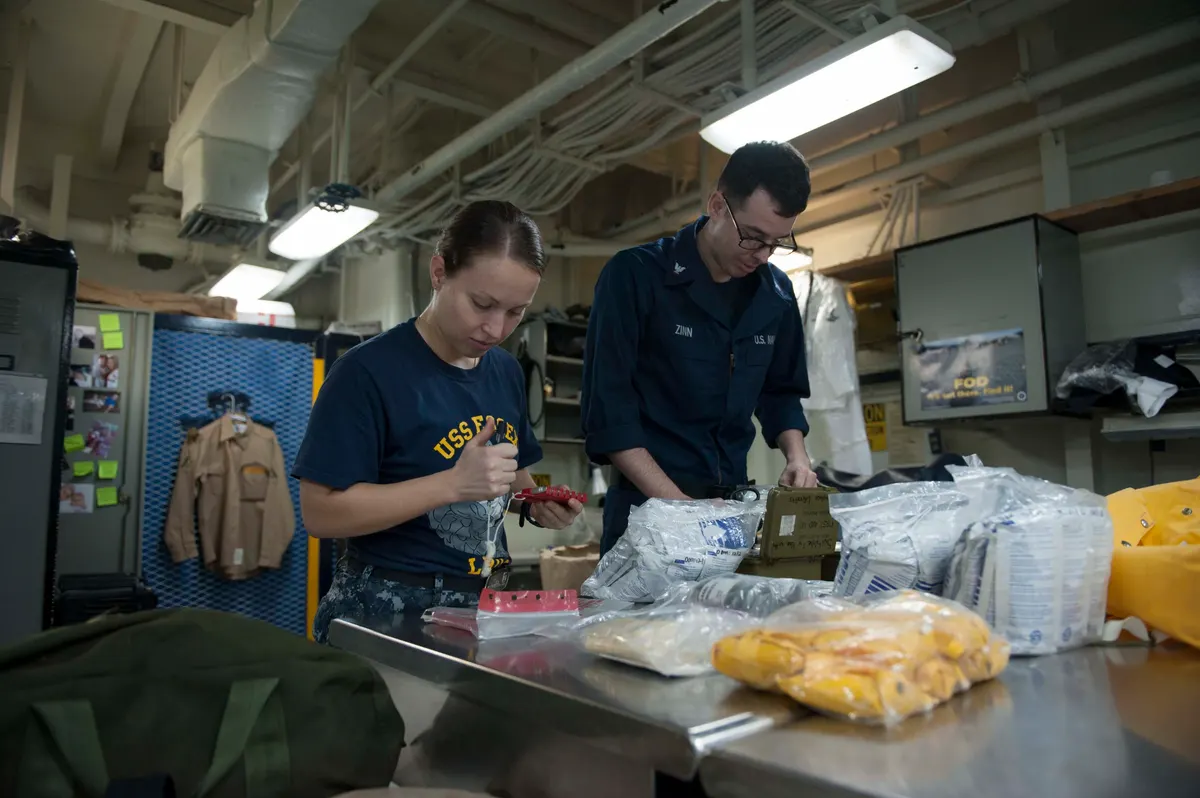
Photo by Seaman Molly Evans · Public domain
Abandoning and staying afloat
- Liferaft
- In-date service and capacity for the whole crew. Stowed where it can be launched fast, not buried under luggage. If the boat has none, one is hired for the passage.
- Self-inflating lifejackets with harness
- One per crew member, individually adjusted and checked: cartridge and CO2 bottle sound. With light and whistle.
- Grab bag
- Prepared abandon bag: water, signals, waterproof handheld radio, documents, medication and a signalling mirror. Kept by the exit.
Staying on board
The statistics are blunt: what saves lives on passage is less about what happens after going overboard and more about not going over. So jackstays get rigged in port, bow to stern on both sides, and the rule on board is simple: at night and in bad weather, harness clipped on any time you leave the cockpit.
- Jackstays and anchor points
- Rigged before departure, with strong points checked. Harness tethers with two clips so you are never fully unclipped while moving.
- Man-overboard recovery
- Lifebuoy with line and light, plus a planned and practised lifting system. Recovering a soaked person over the freeboard is far harder than it looks.
Communications and location
- EPIRB
- Registered to the vessel, or personal PLBs. It is what turns an emergency into a located rescue.
- Fixed and handheld VHF
- With DSC working and the MMSI correctly programmed. A charged waterproof handheld as backup.
- Distress signals
- Handheld flares, rockets and smoke signals, all in date and stowed dry and accessible.
Keeping the boat afloat
Manual and electric bilge pumps tested, with a bilge alarm. Tapered emergency bungs tied by each skin fitting. A tool for cutting rigging in case of dismasting. Serviced extinguishers and a fire blanket in the galley.
And something that is not equipment but weighs the same: the whole crew knowing where everything lives. A proper briefing before departure, with everyone physically handling the gear.
Frequently asked questions
Can a liferaft be hired for a passage?
Yes, and it is common when the boat has none or its own is out of date. We never make a passage without a raft suited to the route.
Is an EPIRB compulsory?
It depends on the authorised navigation zone. On passage we consider it essential, whether or not it is required for that particular boat.
Who pays for missing equipment?
The owner, and it is quoted before starting. They receive the list of what is missing after the pre-departure inspection.