Sailing
Es Vedrà: what it is and how to sail around it
Es Vedrà is the rock rising more than three hundred metres out of the sea off the south-west coast of Ibiza. From land it is impressive; from a boat, when you have it alongside and realise the true scale, it is something else entirely.
Published on
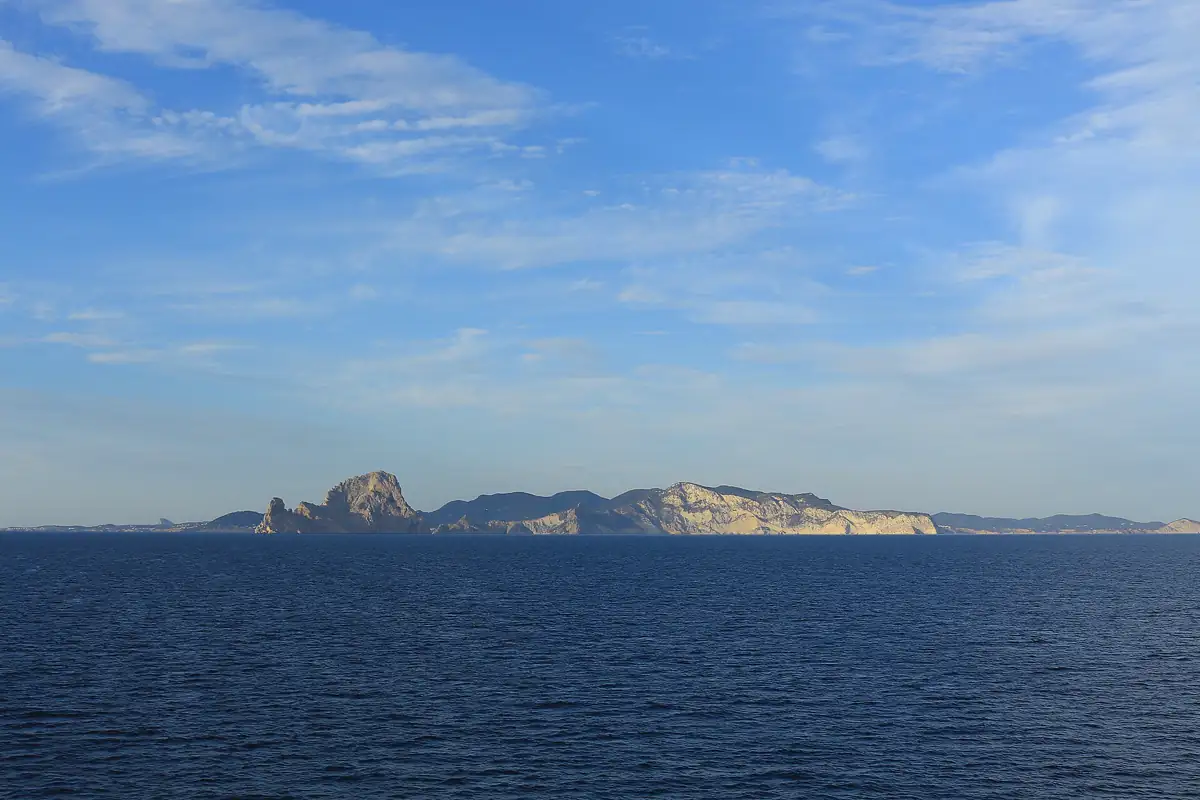
Photo by IsabeauOttolini · CC BY-SA 4.0
What it actually is
Es Vedrà is an uninhabited limestone islet off Cala d’Hort, accompanied by its smaller sibling, Es Vedranell. Both are part of a protected natural area along with the western islets, which means the wildlife, vegetation and nesting birds are covered by regulation.
A whole mythology has grown around it: stories of magnetic anomalies, Atlantis legends and sailors’ tales. We stick to what is verifiable, which is plenty: a mass of rock rising out of deep blue water, and the silence of being there by boat first thing in the morning.
How to approach
The most rewarding approach is from the north, along the coast past Cala Tarida and Cala Vadella. For a while the islet peers out from behind the headland and then suddenly opens up in full: the moment everyone stops what they are doing and reaches for a phone.
You can go round it keeping clear of the rocky shore. There are no usable anchorages right against the islet and landing is not permitted, so the plan is to sail around, cut the engine for a moment and let the scale do the rest.
Where to anchor nearby
Cala d’Hort, directly opposite, is the natural place to anchor and sit for a while with the islet in front of you. It is a sand and gravel cove with several restaurants on the shore and a view with no rival on the island.
Very close by is Sa Pedrera de Cala d’Hort, better known as Atlantis: an old quarry that supplied the stone for the walls of Dalt Vila. Today it is a landscape of stepped blocks falling to the sea, with natural pools between the rock. It is clearly visible from the water and one of the strangest, most beautiful corners of Ibiza.
Timing matters
If you can choose, go late in the afternoon. The sun sets directly behind the islet and for a few minutes its silhouette is cut against an orange sky. In summer that happens around nine, so you need to plan on returning to port after dark — perfectly normal with professional crew.
The alternative is first thing in the morning: less colour, but flat water, clean light and, almost always, the place to yourself.
Frequently asked questions
Can you land on Es Vedrà?
No. It is a protected natural area and landing is not permitted. You can sail around it and anchor opposite, in Cala d’Hort.
Where is the best view of Es Vedrà?
From the sea, sailing around it, and from Cala d’Hort looking straight at it. At sunset the sun drops right behind the islet.
How long does it take to reach Es Vedrà by boat?
From Sant Antoni, around an hour; from Ibiza town, a bit more, going round the south of the island. It depends a lot on the type of boat.